
The Illinois Association of Chiefs of Police (ILACP) has published an article from our founder, Thomas Lemmer, in the Winter 2025 issue of Command Magazine. The article is entitled, Police Leaders Need to Do Better on Gratitude. The article is a companion resource and follow-up to the executive training Lemmer conducted for ILACP members. This training was first presented at the ILACP annual conference held in April 2025. This training was also subsequently provided at the 2025 Midwest Security and Police Expo, the 2025 Breaching the Barricade Conference, and via a live webinar hosted by the Illinois Law Enforcement Training and Standards Board (ILETSB) Executive Institute.
Estimated reading time: 3 minutes
The Article
Lemmer has instructed: “Gratitude must be a guiding factor in how police leaders perform their duties. How they express appreciation is important. When members go ‘above and beyond’ their assigned duties do supervisors express gratitude? Doing so provides encouragement to all members to embrace their duties. Failing to do so can leave those putting in the greatest effort to conclude their efforts are not valued.”
He continued on the power and impact of gratitude: “People receiving gratitude tend to become more grateful themselves, and grateful people experience improved physical and mental health. They are more optimistic, and deal with adversity better. These are clearly valuable traits to encourage among our officers.”
Read the full article below.
Click here to open in desktop full screen or your mobile PDF viewer.
The Gratitude Leading Leadership Model
Under the Gratitude Leading Leadership Model, wellness and positive attitudes about the work and mission of an agency are fostered when its members believe that their efforts are known and appreciated. Expressions of gratitude are an important aspect of leadership.
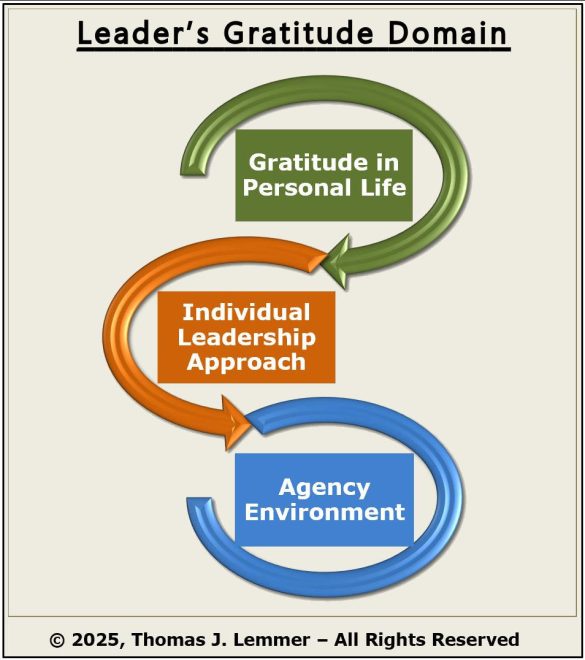
(C) Thomas Lemmer, 2025
A leader’s capacity and effectiveness in understanding and harnessing the power of gratitude exists and develops within three subdomains. (1) The leader’s personal life. (2) The leader’s individual leadership approach. (3) The overall agency (group/team/unit) environment.
Bringing the Model to Your Agency
This article is directly related to several of our officer wellness, supervisory engagement, and leadership training offerings. Comprehensive courses, as well as direct client consulting services are available from Secure 1776. Learn more by visiting our Training and Consulting Services section.
For access to more of our articles formally published in professional journals and magazines, visit our Our Published Articles section.
We are interested in your thoughts, and invite you to comment below.

Thank you Professor Lemmer, another fine article. I have several observations that may be pertinent. I believe splitting a leader’s personal life into two categories would be more clarifying. Continue with the leader’s “personal life” outside of work and add a leader’s “professional life” while at work. When a leader is presented with “hopelessness” in their personal life, they have more options/ control to rebound from their situation. It is quite the opposite for leader’s who experience “hopelessness” in their professional life. They cannot control these “work-related” things: ineptness in the managerial ranks, over-promotion (or merit promotions), lack of career service rank testing opportunities, cronyism, and nepotism. As we know, if a leader experiences “hopelessness” issues in their personal or professional life, it is extremely important that the leader does not let these issues seep into their day-to-day management responsibilities, and expression of gratitude opportunities for those they supervise.
I believe that the “Individual Leadership Approach” link in the Leader’s Gratitude Domain chain needs to identify the individual or collective motivating factors of those they supervise. Leaders who have a small team of individuals they supervise have the ability to take the time and learn motivations for each of the members on their team. This could then guide the leader towards formulating individualist (more personal) expressions of gratitude for each of the individuals on their team. On the other hand, for leaders that supervise groups of individuals or multiple teams, individualist forms of gratitude are impossible. For these leaders developing an all-encompassing form of gratitude should be carefully crafted to demonstrate a meaningful and lasting show of thanks.
In closing, I find it sad and disheartening that we, in law enforcement, have to gauge observations and statistics from a “post Ferguson” and “post Minneapolis” perspective. Do you think we can ever get back to evaluating law enforcement from a “post August Vollmer,” “post O.W. Wilson” or “post Bill Bratton” lens?
Thank you for your thoughtful comments. Just as a lead into my reply, thank you for your long history of demonstrated leadership that exemplifies an understanding and consistent display of gratitude. Those who have worked with and for you know that you are a leader that truly appreciates the efforts of others. You regularly express gratitude to those around you and inspire and foster an embrace of a grateful approach in others.
Now, with respect to your observations, I do note that space limitations in a 1500-word article require the writing approach to be concise. Hopefully you will have an opportunity to attend one of my course presentations. Particularly when I have at least two hours, I am able to draw out the distinctions between the three domains with some additional clarity. In my seminars, I do make use of a two-page worksheet, which I will email to you separately.
I do agree that leaders have a personal life and personal relationships at work that on one level seem to offer a two-part personal life. Under the model, I seek to highlight a different point. The leader’s personal life has an impact on how they lead, and how they lead impacts their workplace environment. Opportunities to adopt a committed perspective of gratitude exists in all three subdomains. As we know, we develop relationships at work that can then become also personal life relationships. For the sake of clarity, in the model the personal aspect of relationships I leave in the Personal Life subdomain. In the training I use some clips for the CBS television series “Blue Bloods.” That show follows the fictional, multi-generational Reagan family. Frank Reagan (played by Tom Selleck) is the NYPD commissioner. He is also the father of several children, including Danny Reagan (played by Donnie Wahlberg) who is an NYPD detective. They have a father-son and a commissioner-detective relationship. Yes those two relationships sometimes overlap, and even at times conflict – but they both exist separately as well. From a leadership perspective, your personal relationships at work are still a component of your leadership approach and how you lead. Clearly, such real-life complexities require balance and integrity to navigate well and appropriately.
As you will be able to see in the worksheet, in reference to hopelessness I was highlighting the macro-level, big picture sense of life, from the perspective of the individual person. A person in the throngs of hopelessness is not a person that is currently in a position to provide positive leadership. They just are not in a positive, thankful, giving place. Within the negative work setting you describe, I would encourage a view toward identifying true positive (and I do not mean to cliché or shallow) rays to build a foundation of gratitude. In the class, I work through an understanding of the reality of struggle in this life — something those of us of faith know that the Highest authority instructed that in this life we will face trials and tribulations. Those individuals who can “count it all joy” — including the struggles — are individuals that are in the firmest position to lead. I know you know the realities of challenges and adversity in life overall, and in holding a formal leadership role in policing. And, I concur with your insights on how the span of control impacts how leaders can sincerely express gratitude to those they lead. If they are at their best, when they embrace a grateful worldview, those closest to them as leaders then also embrace a grateful approach and multiply those positives across even the largest organizations.
In your closing, you again demonstrate the depth of your professional commitment in a way that I draw inspiration from — as you regularly have done in the years that I have know you. YES, we are forced to acknowledge the headwinds we face in life, and in the policing profession. But, we must also ALWAYS identify the tailwinds we benefit from and celebrate them — expressing sincere gratitude. On that note, I say thank you to August Vollmer, Bill Bratton, and all the positive leaders, like George Devereux, who have propelled our profession forward.
Thank you Professor… You need to include your name with the positive leader. You are humble, Sir. Merry Christmas to you and all your family.
BTW, I don’t watch cop television… but my Mom loved that show.