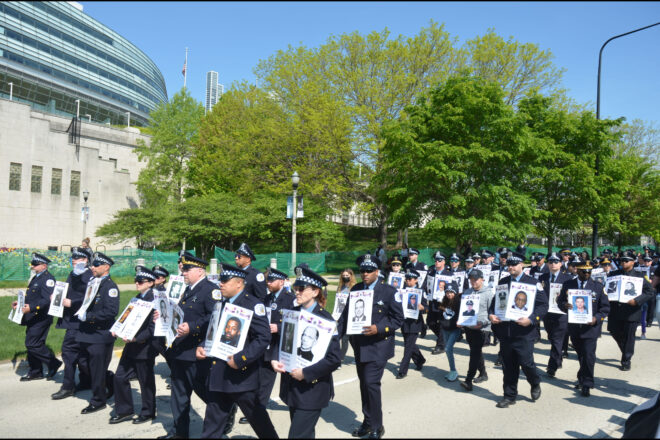
In the midst of the Civil War, President Abraham Lincoln reminded the nation that there was much of which to be grateful. He issued a thanksgiving proclamation to his countrymen in October 1863. He asked his fellow Americans to “observe the last Thursday of November next as a day of thanksgiving and praise to our beneficent Father who dwelleth in the heavens.” The need for a sincere focus and reminder to be grateful remains. Moreover, we need to be grateful for far more than one day each year. Such is true in the nation in general, and with respect to leadership within the police profession.
Estimated reading time: 5 minutes
What is the Focus?
Thanksgiving Day has always encouraged us to look beyond ourselves. For us to express gratitude for our blessings and the assistance and gifts we receive from others. Sadly, Halloween seems to have replaced Thanksgiving as the start of the “holiday season.” With its “trick or treat” tradition and horror themes, Halloween inspires a different focus.
According to CapitalOne Shopping Research, Americans spent $11.6 billion celebrating Halloween in 2024. Between 2019 and 2024, spending on Halloween decorations increased 42%. Among the newer Halloween decoration options are black colored not-Christmas trees. The quaint thanksgiving decorations of years past have been replaced by twenty-foot-tall skeletons. They begin appearing in September, and by November many of them are wearing Santa caps.
Research from Psychologist Robert Emmons has highlighted the benefits of gratitude. When asked about the Thanksgiving holiday, his responses reflect that holiday’s deeper significance. He explained the holiday provides an opportunity for transformational thinking. Thinking about what we have received can “draw us out of our self-involved and self-contained worlds.” Those who live grateful lives are healthier both physically and psychologically.
Gratitude and Policing
Policing has always been an other-focused activity. Across the decades, when police officers have been asked why they joined the profession, the overwhelming majority of them have consistently expressed they had a desire to help people. On this point alone, there is reason for gratitude.
Secondly, in all but a one-person department, police chiefs and sheriffs (and their agency’s supervisors) must rely on the work of others in order for their agency to fully meet its mission. This reality is inherently understood, which raises a key question. Overall, are our law enforcement agencies ones that their members would describe as being places where gratitude is a priority?
In far too many agencies, probably not. Working in policing should not be a “trick or treat,” horror-themed experience. The work is far too essential, and those undertaking the mission are far too valuable. It is a core responsibility for those holding formal leadership positions within policing to be intentional in regularly expressing gratitude to their officers.
Grateful Police Leaders
Within policing, the purpose is public safety, and in meeting this mission we ask a lot of our officers. Sincere expressions of gratitude for those efforts are essential, as our officers are more likely to continue to extend themselves for others (often at great personal risk) when they believe that their efforts are valued and appreciated.
The importance of this fundamental point is not something that leaders should leave unstated among their agency’s supervisors and command staff. It needs to be a clearly stated priority. To this point, police executives must take the lead in demonstrating gratitude within their organization. They must also ensure that the agency’s supervisors understand and practice these principles. Without question, collectively the continuing efforts of our police officers regularly give us all reason to be thankful. Those in leadership need to show it.
A Model for Leaders
In considering police supervision, and the research on gratitude, I have found that a leader’s capacity and effectiveness in understanding and harnessing the power of gratitude exists and develops within three subdomains. First, the leader’s personal life. Second, the leader’s individual leadership approach. Third, the overall environment of their agency (group/team/unit).
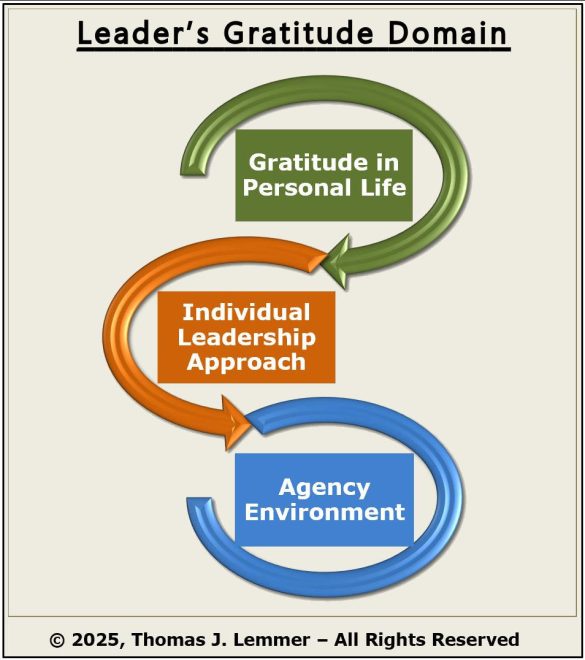
When I train police leaders on this model, I remind them about their own wellness needs. Those who believe there is nothing in life for which to be grateful are clearly in the midst of hopelessness. Such a person is not in a position to lead. Similarly, the person who is grateful only when things are easy is not strong enough to lead in difficult times.
Gratitude must be a guiding factor in how police leaders perform their duties. How they express appreciation is important. Demonstrating that the efforts of their officers are appreciated contributes to the overall wellness of both the officers and the supervisors expressing gratitude. People receiving gratitude tend to become more grateful themselves, and grateful people experience improved physical and mental health. They are more optimistic, and deal with adversity better.
Finally, every organization develops its own culture, which influences how members see their roles and interact with others. An organization’s environment identifies what is valued and prioritized, which drives the agency’s effectiveness in meeting its mission. I encourage every police leader to rededicate themselves to building an agency culture that embraces gratitude. If your agency needs help in this area, reach out – take action.
This Thanksgiving Day and After
I remain profoundly grateful for the countless blessings that fill my life. My very life, my family, my freedoms as an American citizen, and the friends and colleagues who strengthen me. I thank God for them. For the opportunity to continue to serve my chosen profession, I am thankful. I am grateful for the examples of courage and leadership from those who came before me, and from those with whom I served. I am thankful that so many continue to wear the badge, patrol with selfless dedication, and answer the call. God bless and watch over you all.
Happy Thanksgiving.
We are interested in your thoughts, and invite you to comment below.